This site is copyrighted, supported, and maintained by the Equal Justice Foundation.
| EJF Home | Join the EJF | Comments? | Get EJF newsletter | Newsletters |
| DV Home | Abstract | Contents | Tables | Index | Bibliography |
| Chapter 12 — Stories Of Violent Women And Abused Men In Colorado |
| Next — Violent Colorado women-Year 2015 |
| Back — Violent Colorado women-Year 2013 |
[Comments by the Equal Justice Foundation are in Courier font.]
Arvada woman sentenced to 208 years in prison
Woman arrested after stabbing man in southwest Colorado Springs
Colorado Springs woman arrested after assaulting police officer at TESSA
Colorado Springs woman tries to kick police officer in the balls after being arrested in domestic dispute
Aurora attorney gets 2 years probation for kidnapping hoax
Colorado Springs woman accused of twice trying to kill man she lived with for insurance
Denver police fire female cop for repeated on-duty sex
Swinger party leads to charges against Denver police officer and his wife
Fountain woman arrested after stabbing man
Centennial woman starts apartment fire when her lesbian lover leaves her for a man
Air Force Academy cadet acquitted of rape and sexual abuse charges
Woman goes berserk and shoots man for no reason in Aurora
Denver sheriff's deputy, Debra West, arrested for assaulting her wife over lost keys
Colorado Springs woman arrested after shooting man and herself
Abstracted from stories by Kirk Mitchell, The Denver Post
and Michael Roberts, Westword
January 2014
— The story begins in early 2014, when Jana Bergman, 32, answered 88-year-old Jack Wood's ad for a housekeeper even though she was residing in Denver County Jail at the time.
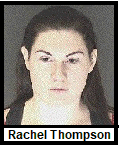
Her status as an inmate didn't scare off Wood. He corresponded with Bergman by phone call and letters — and after she claimed to love him, he posted her bond and moved her into his Arvada home where she repeatedly assaulted him beginning in January.
Over the next ten months, Jana Bergman was arrested on numerous additional occasions, and each time, Jack Wood bailed her out when she wrote him letters saying she loved him.
When Ms. Bergman was angry she would take Jack Wood's car and disappear for days at a time. He's said to have spent a cumulative $12,000 in bond fees buying her freedom, and even used his house as collateral to get her out of jail on one occasion.
On November 10, Jana Bergman responded to an argument with Mr. Wood by pushing and kicking him down a set of stairs — and when he grabbed onto a railing in an effort to protect himself, she pulled at his arms so vigorously that some of his skin was torn off.
Ms. Bergman continued her assault once he reached the bottom of the stairs, holding him down with her knee, snatching his wallet and keys and driving away in his car — but not before cutting off her ankle monitor and leaving it on a table.
Jana Bergman was convicted in October, 2015, of attempted manslaughter, first-degree assault, second-degree assault, robbery of an at-risk adult and menacing, among other violence-related charges. She has four prior felony convictions and on November 9, 2015, she was found to be a habitual offender and sentenced to 208 years in prison.
January 22, 2014 — A woman was arrested Wednesday after a man's screams for help alerted residents of a southwest Colorado Springs neighborhood and police found him bleeding from multiple stab wounds. police said.
Chelsea Mata, 24, of Colorado Springs, was arrested on suspicion of first-degree assault and booked into the El Paso County jail, court records show.
A neighbor called police at 12:40 AM when he heard a man in the 300 block of Crestone Lane yelling that he had been stabbed. The victim suffered multiple cuts to his right arm, but was able to give police descriptions of a man and a woman involved in his attack.
Police said that led them to Ms. Mata and a man, who was released.
February 12, 2014 — Colorado Springs police have arrested 37-year-old Alecia Zaher on charges of second -degree assault on a peace officer.
Officers responded to an 8:45 PM call of a disturbance involving an intoxicated woman at TESSA on 435 Gold Pass Heights off Highway 115.
Police said a female officer tried to handcuff Zaher when she resisted and became combative. After fighting to get her under control, the officer deployed her Taser. An additional officer arrived to help with the arrest.
The female officer sustained minor injuries from the assault and was treated and released from the hospital.
Alecia Zaher was also treated for injuries. She was later transported to CJC and booked on felony charges of second -degree assault on a peace officer.
March 20, 2014 — Tiffany Berndt, 34, was arrested shortly before 10:30 PM on suspicion of second-degree assault on a peace officer, according to Colorado Springs police.
Officers originally planned to take Ms. Berndt to the detox facility after being called to a domestic dispute at a motel in the 4300 block of N. Nevada Avenue. When officers put her in a police cruiser, she began kicking the rear door. When an officer approached she kicked him multiple times in the lower abdomen, police said.
Abstracted from story by Ryan Parker, The Denver Post and subsequent news reports
April 27, 2014
— Westminster police were asking the community for help in locating a missing woman who reportedly was previously was kidnapped in March.

Aurora attorney Becky Lynn Keil, 50, was last seen leaving her home about 6 AM Monday, according to a news release from Westminster police. She is practicing law in the Aurora area.
Ms. Keil missed several appointments throughout the day and was reported missing by her son at 3:30 PM, police said.
Becky Keil was supposedly also the victim of a kidnapping in March. But investigators found quite a different story. Westminster police found she lied about being abducted in two separate occasions in March and April.
She was charged with false reporting and attempting to influence a public servant in August 2014 and convicted for these crimes in January 2016.
She was sentenced by an Adams County judge to serve two years of probation for twice faking her own kidnapping in 2014; and her license to practice law was suspended for two years.
May 6, 2014 — A woman indicted this week on charges of attempted murder allegedly tried to kill her roommate once in 2005 and then enlisted help in a second attempt in 2009, according to court documents.
The motive? To collect on an insurance policy Tammy Lynn Fritz had taken out on her roommate in 2005, the indictment reveals.
Ms. Fritz, 47, Michelle Kay Heaston, 40 and Sean Richard Lagoe, 42 were indicted by a Grand Jury on charges including attempted first-degree murder and conspiracy to commit first-degree murder. Tammy Fritz also was charged with solicitation to commit first-degree murder.
According to court documents, Ms. Fritz and the victim, James Bowden, lived together for several years but were not romantically linked. Lagoe was Ms. Heaston's boyfriend in 2009, according to the indictments.
A month after taking out the life insurance policy on Bowden with herself as the sole beneficiary, Ms. Fritz tried to kill him by setting their home on fire on June 30, 2005, the documents state.
Tammy Fritz and James Bowden had returned home from a night of drinking when Tammy helped him to bed, lit a few candles in his room and turned on a fan, sparking a fire that the Colorado Springs Fire Department and the El Paso County Sheriff's Office responded to, the documents said. Bowden was rescued from the home and survived.
Four years later, in the summer of 2009 when Ms. Fritz was no longer living with Bowden, she employed Heaston and Lagoe to kill him the night before he was set to catch a flight for a move to Alaska, the documents state.
The documents indicate the victim was attacked by Lagoe with a baseball bat but reveal few other details.
Fritz had agreed to take Bowden to the airport on the morning of August 3, 2009, but when she arrived, he didn't answer his door or his phone, so she left, according to court documents.
Several witnesses told investigators the trio had spoken about the attack and the insurance policy, court documents state, and investigators found letters between Lagoe and Ms. Heaston that referenced the alleged murder plot.
It's unclear from court documents what happened in the five years leading up to this week's indictment.
On September 19, 2014, Michelle Heaston was given a 15-year suspended prison sentence and six years of probation after pleading guilty to first-degree burglary. The attempted murder charges against her were dismissed so she walks. Her accomplices still await trial.
Abstracted from stories in Westword and CBS Denver
May 16, 2014
— The Denver Police Department has fired one female patrol officer and her married Denver Police Department boyfriend has resigned after he admitted the two had sex while they were both on duty
“approximately 25-30 times”
over the course of a year-and-a-half.

Stephanie Southard, 26, a patrol officer since 2008, was ordered fired April 14 for violating three department regulations including sexual misconduct and lying about having sex on duty. Southard is appealing her firing.
Officer Nathan Sanchez resigned after he admitted sexual contact with Southard while both were on the clock. An attorney for Southard said she would have no comment.
Southard and Sanchez become the fourth and fifth Denver police officers disciplined in recent months for sexual misconduct on duty.
During an internal affairs investigation, Sanchez said he and Southard became friends through work but the friendship quickly turned sexual.
According to the internal affairs investigation obtained by CBS4, “Officer Sanchez stated that 'approximately 25-30 times' he had unzipped Officer Southard's uniform pants while they were both on duty,” and proceeded to have sexual contact. Officer Southard denied the on-duty sex but said “they only held hands and hugged each other (at work).” But Denver's Deputy Director of Safety, Jess Vigil, ruled that Sanchez was “credible” and that he and Southard “engaged in repeated sexual contact while on duty.” Reportedly Southard also performed oral sex on Sanchez while they were on duty.
Southard and Sanchez join a growing number of DPD personnel recently found to be focused on sexual pursuits when they were supposed to be chasing crime.
At a July hearing Sanchez that as he attempted to end the affair Southard, on different occasions, scratched him on the neck, backhanded him in the face, and “flailed” at him. He also stated that he and Southard had sex the same day he told her the affair was over. Apparently at some point she also stuck her gun in her mouth.
In November 2013, the Denver Post revealed that Stephanie Southard had been charged with misdemeanor harassment owing to a June incident during which she's said to have socked Nathan Sanchez after he ended their affair.
An affidavit cited by the Post maintained that Southard walked up to the driver's side of Sanchez's vehicle in a Glendale parking lot, and at the sight of his wedding ring, she “grabbed and hit Sanchez's face as he turned his head away,” knocking off his glasses and leaving a scratch near his eyebrow in the process.
Abstracted from Associated Press and Westword articles and other news sources
May 19, 2014 — A Denver police officer and his wife have been charged with assault, harassment, and child abuse after a brawl at a cookout.
Jeremy Ownbey and Steven Sloan were said to be best friends who entered the police academy together and even took joint vacations. According to a May 2014 Aurora Police Department report, they also shared other things — specifically, their spouses
Arapahoe County prosecutors charged Denver Police Officer Jeremy Ownbey and his wife Jamie Ownbey with misdemeanors stemming from a drunken brawl. An argument turned violent between the Ownbeys and Steven Sloan and his wife Stephanie after heavy drinking at a party at Sloan's house.
Steven Sloan, who is also a Denver police officer, asked the Ownbeys to leave, at which point Mrs. Jamie Ownbey struck Sloans wife, Stephanie, from behind. Then, the officers started fighting.
Reportedly Steven Sloan “ started to fight with Jeremy, with both of them throwing punches at each other.... He admitted to not winning the fight, and after being punched numerous times in the head, he felt as if he was going to lose consciousness.”
Officer Sloan then “ went to get his gun from his truck because he was in fear for his safety and thought he was in danger,” the report continued. “Steven stated he punched Jamie in the face for punching Stephanie, and Jamie fell to the ground. Jeremy punched Steven in the face for punching Jamie. Steven stated he then punched Jeremy.”
Jeremy Ownbey said Steven Sloan pointed the weapon at him, but police could not prove it. After that, Steven ordered Jeremy to leave. But Jeremy didn't split until a 911 call was made — and by the time he returned, Aurora police officers were on the scene.
Investigators say Ownbey and Sloan acknowledged that they and their wives trade sex partners, but they denied that sex sparked the brawl. The fight ended when Sloan managed to break free and retrieve a gun.
Jeremy Ownbey and his wife then drove away after a night of drinking. But Jeremy later returned to Sloan's home to talk to Aurora police officers. No arrests were made that night because the case warranted further investigation by a detective.
Both Denver police officers were put on desk duty while that department conducted its own internal probe.
Jamie Ownbey was charged with third-degree assault and harassment but the charges against her were later dropped when Stephanie Sloan refused to testify.
Criminal charges against Jeremy Ownbey were also dismissed — but he was suspended from the Denver Police Department for ninety days because of his actions. The criminal allegations against Jeremy fell away by the end of 2014.
June 1, 2014 — The Fountain Police Department says a man was stabbed in the 500 block of Royalty Place.
The victim was found at a nearby motel at around 10:30 PM.
Police say the stabbing happened during a fight.
The suspect in this case is Joyce Freeman. She was arrested and is facing charges for assault.
The unidentified victim suffered a serious stab wound but is expected to make a full recovery.
Abstracted from stories in Westword and other sources
June 23, 2014
— A fire in building G of the Copper Terrace Apartments, 6550 South Dayton Street in Centennial began around 1 AM. The fire trapped virtually everyone on the second and third floors of the apartment building. Eight people were hospitalized as a result of the blaze, one of them is in critical condition. Numerous individuals had to leap from their apartments in order to escape the flames.
At least four units in the building were destroyed or heavily damaged before the fire was extinguished. Damages were estimated to exceed $1 million.
One boy described jumping from the third floor on to a mattress some quick thinking individual brought out. His 10-year-old brother and parents climbed down a makeshift rope made of bed sheets and blankets.
They were far from the only ones.
A neighbor backed a pickup truck up to the burning building and mattresses were thrown in the bed of the truck to cushion the fall for those who wanted to jump.
Their neighbors all had similar stories to tell of their own evacuations.
“I got hit with a bunch of heat and flames,” one woman said. “It singed my eyelashes and part of my hair. I burnt my hand trying to close the door.”
“I didn't know if we were going to make it out in time,” said Lenise Ruff, who suffered second degree burns on her hands and jumped out of her third story window with her roommate, Marilyn Kruc. Kruc underwent surgery for two broken vertebrae but was expected to make a full recovery.
“It's great that we could all, just that quickly, all come together to do something to help,” one said.
Investigators found the fire on June 23 rd began in a stairwell in building G of the apartment complex. Within a day of the fire, Undersheriff Louie Perea said investigators found evidence suggesting that arson was a strong possibility. The evidence included signals from arson dogs trained to smell chemical accelerants.
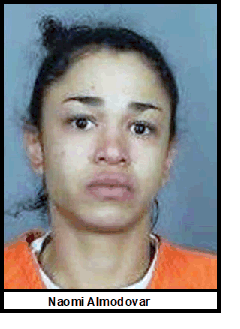
Naomi Almodovar, 23, was arrested July 18 th and charged with criminal attempted first-degree murder, first-degree arson and domestic violence. Ms. Almodovar was transported to the Arapahoe County Sheriff's Office Detention Facility and is being held without bond. Deputies said additional charges against her are pending.
In court the following Monday, prosecutors said they plan to charge Almodovar with more than 37 counts of attempted murder plus arson-related charges. Bond was set at $1 million.
An arrest affidavit obtained by Fox31 offers law enforcement's version, which suggests that Naomi Almodovar set the apartment on fire in an act of revenge over a shattered love affair.
According to the document, Ms. Almodovar and the woman had been involved in a five-year relationship described as “intimate.” But following a breakup, the woman got involved with a man who lived at Copper Terrace.
Apparently that situation led to a series of escalating crimes. On one occasion, Naomi Almodovar tried forcing her way into the man's apartment after sending a text warning the former girlfriend that she'd “destroy everything you love and everything you try to love.” Ms. Almodovar subsequently rammed the man's car in the parking lot. The result was a domestic violence charge.
A few days later Ms. Almodovar choked her former lover after they “ran into each other” at a Walmart. After that the woman discovered that her tires had been slashed when she returned to her car.
Investigators believe these offenses were mere prelude to a larger crime. A week before the fire, the report notes, Naomi Almodovar's former girlfriend and her new boyfriend became “Facebook official.” On seeing that post Ms. Almodovar reportedly responded by stabbing herself in the ribs, then telling her ex that she would kill for her.
As for what happened next, the account cited in the affidavit is attributed to a friend of Naomi Almodovar's who was arrested in mid-July on an unrelated drug charge. During interviews with investigators, Fox31 reports, she said she and Ms. Almodovar had gotten high a few hours before the fire started, after which Ms. Almodovar filled a gas can with $5 worth of fuel.
Next, the friend said she dropped Almodovar at an apartment complex — she wasn't sure which one — but its features were apparently similar to those at Copper Terrace. Her friend said Naomi was upset when she returned ten to fifteen minutes later, shortly before the blaze broke out in earnest.
Abstracted from story in the Colorado Springs Gazette
October 2014 — Cadet Zachery L. Chubb, a football player for the Academy, was accused of fondling a female cadet and forcing her to touch his genitals during an academy dorm room encounter. He was courtmartialed on one count of rape and two counts of sexual abuse. But months of legal wrangling delayed his courtmartial trial until March of 2016.
At his courtmartial a panel of eight officers — four men and four women — after hearing testimony deliberated for several hours before deciding Cadet Chubb was not guilty of the charges against him.
Defense lawyers painted the victim as a conniving woman who lied about the charges so she could avoid getting in trouble because of her poor grades. Witnesses said the woman was on academic probation but was allowed to take time off from the academy and later to restart her schooling after she reported the alleged sexual assault to counselors at the academy.
Witnesses also said the woman told friends that she did not know if she'd been raped and even other female cadets didn't support the supposed victim.
“I don't trust her,” testified cadet Gabrielle Gray, a former roommate of the woman.
“In my opinion, she's not truthful,” said Cadet Waverly Hock, another former roommate.
Abstracted from story on KDVR/Fox 31 News
October 21, 2014
— Joel Mary Felix, 37, was drinking alcohol and smoking crack cocaine at a friend's house when she became confrontational and accused other people in the home of stealing from her.
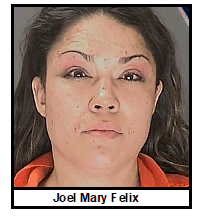
From there she moved on to the front porch where she was yelling and waving a gun. “With no provocation she shot a 36-year-old man who was in a nearby driveway,” the district attorney's office said.
The man was shot in the stomach and lost 12 liters of blood.
“If it was not for the pure luck of having a combat veteran and an off-duty police officer within seconds of where the victim fell, and the extraordinary work of the emergency staff at the hospital to save the victim, his life would not have been saved,” senior Deputy District Attorney Gary Dawson said.
At the time of the shooting Ms. Felix was on probation for her second and third felony convictions. Illustrating how worthless gun control laws are, District Attorney George Brauchler said in a statement that “The conduct here was outrageous...Firearms should not be in the hands of convicted felons and crack users.”
Extraordinarily, for someone with two previous felony convictions, Joel Mary Felix received only a 25-year sentence for assault with a deadly weapon and 12 years for felony menacing, with the sentences to be served concurrently.
December 17, 2014
— A Denver sheriff's deputy has been arrested and accused of assaulting her wife in a dispute over lost car keys, according to Littleton police records.
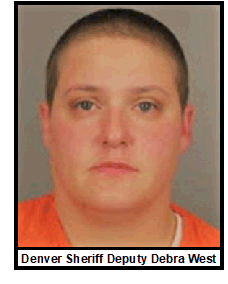
Littleton police arrested Deputy Debra West, 34, at her West Powers Avenue apartment on Wednesday morning. She was booked into jail for misdemeanor domestic-violence assault and harassment, according to a police report. Deputy West works in the Denver jail, which has been rocked by numerous scandals during 2014.
Just after 9 AM 31-year-old Keesha West called Littleton police to report a domestic violence incident with her wife, Debra West.
When officers arrived, Keesha West told them couple had been arguing that morning, because Deputy West was upset that her car keys were lost, according to a police report.
The argument escalated and Keesha said Debra West ran at her and pushed into a wall. Keesha said Debra punched her in the arm and then shoved her to the floor and got on top of her, straddling her with her legs. Keesha said Debra then rifled through her pockets trying to find the keys. Keesha said when she tried to shove her wife off of her, Debra punched her twice in the face, breaking her glasses.
An officer checked Keesha's arm, where she said she claimed to have been punched, and took photos of redness on her upper left arm near her shoulder. The officer also found Keesha West's eye glasses on the floor and noted the frame was bent “consistent with being damaged when the left side of K West's face was hit,” the report said.
Keesha West told the officer that she might have struck Debra in self defense while trying to get her wife off of her.
Keesha also showed the officer text messages she received from Debra West “telling her not to call police or her children would be taken from her,” the report said. Keesha's four children were not in the home during the altercation.
Police interviewed Debra West outside the apartment. The deputy told officers that Keesha was verbally “harassing her about everything.” Deputy West told police “there was a scuffle” between her and Keesha and struck her in the left side of the face. The officer saw redness on the Debra's left cheek and photographed it. Police then arrested Deputy Debra West on suspicion of domestic violence assault.
Keesha West told police she later found Debra West's car keys in the cushions of the couch in the living room.
Keesha West also told police that about a month earlier, police had been called on another disturbance between the two women. Keesha said that she did not tell officers at the time, but prior to calling police that day Debra West had “put a gun to her head and threatened to kill her,” according to the police report.
Police confirmed that officers had been called to the apartment earlier and that Debra West owned a handgun that was kept in a safe in the apartment. Deputy West has not been arrested or charged in connection with Keesha West's allegations about the gun incident.
Abel's unfortunate saga begins and ends like so many other poor souls who thought that marriage necessarily provided the stability we tend to need as we get older and wiser and settle down in our lives. Abel believed he had that stability with his wife, as they had been married a solid twenty years and Abel's career was going well; a career Abel most certainly did not want to jeopardize.
Unfortunately for Abel, the twenty years of effort spent in his marriage would leave him with nothing more than a bad taste in his mouth as one fateful night demonstrated that his commitment to the marriage was very one-sided.
In the middle of December 2014 Abel, 55, his oldest brother Cain, and his wife Jezebel, 45, were having dinner at his house. Abel decided to go to bed early as he had things to do early that next morning. Abel woke up later that night; shortly before midnight and noticed his wife was not in the bed. Abel also checked the house to find that she was not there. Abel then looked outside to see Jezebel sitting in his brother's lap by a fire.
Acting on a gut feeling of other affairs in the past, Abel watched them for a moment to see how far it went. As Abel approached the two of them he heard her moaning and groaning and kissing his left ear. The realization that Jezebel was having an affair with his brother Cain sank in.
After telling his brother to leave, Abel retreated into the house where Jezebel followed. He could tell she was drunk as she just swayed and stared at him.
The following day, Abel knew all the other gut feelings about his wife having affairs were more than likely true. This hit Abel like an epiphany. The fact that his wife was confident enough to seduce his own brother at their home, and while he was there brought this all to light.
Abel decided he would file for divorce after the holidays because he was not about to put up with Jezebel's lies and cheating that were so mentally and emotionally destructive for him. Although he had made up his mind, Abel said nothing to his wife about the previous night.
About two weeks later on New Year's Eve, Abel, Jezebel, and his two brothers were having the traditional New Year's Eve dinner at his house in Pueblo. Abel had decided he wanted to have one last good memory of his wife and oldest brother before he filed for divorce.
Abel, Jezebel, and two brothers had dinner, enjoyed some drinks and watched the fireworks for the New Year. Abel's oldest brother, Cain, left the house before midnight. Abel's younger brother had driven down from Trinidad and decided to sleep on the couch right outside the master bedroom that night.
Around 3 AM Abel and his wife retreated into the master bedroom to call it a night. Again, Abel had to get up early that morning and elected to go straight to sleep while his wife was supposedly getting ready for bed.
Jezebel, however, was feeling a little frisky and wanted intercourse with Abel. With the affairs fresh in his mind, Abel declined and instead asked his wife to leave the master bedroom and sleep in the other room. Jezebel repeatedly asked why until finally Abel asked her: “How long have you been fucking my brother?” She became offended and Abel asked her to leave the bedroom. He would have been fine with her simply leaving the room until he saw her getting the car keys out of her purse. Abel took the keys from her as she was intoxicated and he did not want her to drive.
After falling asleep for approximately thirty minutes, however, Abel awoke to the sound of the garage door opening and noticed the car keys were missing. He ran outside to see Jezebel just pulling away in his Jeep; he was too late to stop her.
Abel knew his wife was intoxicated. Abel called Cain's wife, Mary, and told her that he had discovered; Cain and Jezebel were having an affair. After some contemplation, Abel called the Pueblo County Sheriff to report his wife being intoxicated and out driving. Abel explained to dispatch that Jezebel was drunk and that he had tried to stop her; but she left in his jeep.
Sometime later on New Year's morning, Jezebel found herself stuck in Custer County where she reportedly believed she was in the hardscrabble campground. Instead, she was actually on private property where the owner proceeded to contact police because of her intoxicated status.
When Custer County Deputy Wenzel asked Jezebel what happened, she said that she got into an argument with her husband at their house in Pueblo West. She said she left the house leaving her license and purse, got in the Jeep and just started driving. She said she did not know where she was going. Deputy Wenzel, the arresting officer, did not see any scratches, bruises or redness on Jezebel. Deputy Wenzel noted in his report that she stumbled out of the jeep and he had to help Jezebel to the patrol car where she was handcuffed.
At 6:43 AM the Custer County sheriff's office left a voice mail message for Abel that Jezebel had been picked up for DUI because her blood alcohol content was 0.099. Abel was asked to come and bail his wife out of jail but declined to do so. He was then asked to bring her driver's license and he would be given the keys to his vehicle to try and retrieve it.
The Pueblo County Sheriff showed up at Abel's house at 06:49, where Abel explained the situation to Deputy S. Blair. He also told the deputy that Jezebel had tried to get him to hit her. Abel told the deputy there was no physical altercation between him and his wife. If he had, Abel would have arrested on the spot for domestic violence. After the officer walked through the house looking for signs of domestic violence, he told Abel there was nothing they could do because the vehicle was marital property and he left.
At this point, Abel had been on an emotional roller coaster that anyone would need to take a step back from. After five days of this, Abel started cleaning the kitchen and found his wife's bottle of vodka. As he normally didn't drink liquor, he intended to pour it down the sink but decided instead to drink the vodka.
Abel then started watching Spaghetti Westerns and, out of sheer grief, Abel even momentarily had suicidal thoughts as his entire world was crashing down on him. Abel received a text from Jezebel's sister that she had just found out about what was happening and that Abel did not deserve this. Abel's sister in-law gave Abel needed support and Abel quickly broke free of his suicidal thoughts. What he did next; however, would prove disastrous to his already heart-breaking situation.
Abel had recently been target practicing and left his guns on the counter intending to clean them. While texting Jezebel's sister, Abel took a picture of the guns and captioned it “Coming for justice.”
Abel made the stupid mistake of sending the text and photo to his Jezebel's sister in what he thought was an effort to let her know that Abel was no longer suicidal. Unfortunately, Jezebel's sister naturally had a different interpretation of the picture and forwarded the text to her mother. The two of them then went to the Pueblo police the next day to file a domestic violence report.
The domestic violence report was all that was necessary for Jezebel to absolve herself of the situation entirely. The simple claim of fleeing a situation of domestic violence allowed Custer County to drop the DUI charges against Jezebel. But before they would drop the charges the Custer County DA called the Pueblo County district attorney to make sure the charges of domestic violence were filed against Abel. Abel was then arrested and charged with simple harassment, an M3 misdemeanor.
This misdemeanor charge, standing alone is not such a big deal, but the court found the charge included an act of domestic violence when it issued the warrant for Abel's arrest. The add-on of domestic violence required mandatory restraining orders and the relinquishing of all Abel's weapons and ammunition. Abel was then called by a Pueblo County Deputy and asked several questions over the phone. The deputy asked Abel if he grabbed his wife and Abel responded “ I don't think so.” The questioning then became more aggressive, as it usually does, and Abel responded “ I may have, I'm not sure.” Keep in mind Abel did take away the keys from Jezebel in an effort to keep a drunk off the road.
Abel, having never been in trouble with the law before and knowing that he had not assaulted his wife in any way, pled not guilty to the charges. Abel put his faith in the justice system as he was taught that if you're innocent, the truth will prevail. Abel, as the uninformed unfortunately and consistently do, believed that he was not guilty. He hadn't done anything wrong and surely a jury would see that. Abel's innocent assumption that the courts and the judicial system were about guilt and innocence would come back to haunt him. The District Attorney's Office offered Abel a plea deal which Abel declined to accept and elected to instead let a jury hear the facts — all of the facts.
Abel hired what he thought was a good attorney as he prepared for trial. It is important to note that once Abel's attorney received the discovery from the District Attorney's Office that it included the booking videos labeled # 2 and # 3 disks, and photographs of bruises located on his wife's forearm and upper arms. These marks were supposedly left on Jezebel on the night in question and gave rise to the charge of assault.
The #1 disk that was not turned over to Abel's attorney was believed to be the dash camera video of Jezebel's arrest. As Abel, noted the photographs of Jezebel's bruises were taken five days later and are inconsistent with the story his wife had told police, Abel believed the video would have shown her intoxicated status and the fact that the police report had indicated the deputy had to “help her” into the patrol car. The bruises in the photographs, inconsistent with Jezebel's story, did appear to be consistent with police pressure point control tactics and most certainly would have been warranted to control an unruly and intoxicated individual.
Abel's attorney, John Newsome, who Abel paid about $7,000, promised to aggressively defend Abel. He pledged to file a multitude of motions, call Abel's sister-in-law for her testimony and attack all of the inconsistencies with Jezebel's story, as well as the evidence.
In the end, however, Newsome did not call his wife's sister, did not file any motions, did not aggressively cross-examine Jezebel, or attack any of the inconsistencies related to his wife's story and the arrest. What this attorney actually did is considered ineffective counsel. Thus, the trial boiled down to nothing more than a he-said, she-said argument for the jury. Ultimately, with the photograph of Abel's guns captioned “Coming for Justice,” and Jezebel's testimony claiming she had endured years of emotional and physical abuse, Abel never stood a chance.
Abel now admits how unprepared he felt and how rushed the entire proceedings seemed to be. At one point, getting a fair trial was even questioned because the Jezebel's cousin sat on the jury. As the juror was challenged as biased, Judge Lobato asked if the juror thought he could be fair. He simply answered yes and was allowed to remain seated on the jury. Apparently neither County Court Judge David Lobato or Abel's incompetent attorney felt this was a concern.
The EJF notes that according to the 2018 state ballot information booklet and recommendations on retention of judges, Lobato's open caseload is greater than the established goals of completing 80% of all cases within six months. Judge Lobato offered reasonable explanations for his backlog, but agreed that he is not unmindful that this situation needs improvement.Abel believes Judge Lobato's main concern was not for Abel's fair trial, but for the backlog of cases at Abel's expense.
Jezebel resorted to playing the helpless victim role and bashed Abel for twenty years of marriage in which she claimed he physically and emotionally abused her. This tactic is common in domestic violence proceedings. Although in some cases this may be true, common sense dictates that there surely should be something, anything more than an alleged victim's word to substantiate such a claim. As is true in Abel's case, however, simply making the accusation was sufficient. That deflected blame to Abel from her! A necessary step because she was having an affair and decided to drive drunk that night. Clearly, everything had to be his fault as she claimed he had abused her for so long.
Although Abel had never been in trouble before and the police had never been to the couple's house in the past for any allegation of domestic violence, still, after a day-and-a-half trial to a jury that included Jezebel's cousin, Abel was found guilty.
Had the charge been simply harassment without the add-on of domestic violence, the consequences for Abel would have been far less severe. Instead, and under these very bizarre circumstances, Abel is prohibited from owning a weapon or ammunition. Abel also had to feed the “justice” machine. He estimates that just his ankle monitor rental was ~$2,000. Of course he also has to pay for his probation officer and for the domestic violence classes he was ordered to undergo for approximately four months. In addition Abel was ordered to pay restitution of $2,000. Nor, as noted, was his attorney free.
It's also important to note that only an accusation of having an alcohol-related problem was necessary to cause the court to require Abel be evaluated by Health Solutions. Judge Lobato's actual response to Jezebel's bare accusation was “I'm not entirely convinced you don't have an alcohol problem.” Abel endured an evaluation that found he did not have any problems with alcohol.
In the end, Jezebel walked away from the situation smelling like a rose. After twenty years of allegedly being abused, she suffered no repercussion from driving under the influence on the night in question, no responsibility for her infidelities, and no responsibility for any of her actions whatsoever.
As a result, during the ensuing divorce she walked away with alimony, half of Abel's retirement, and will be remembered by many as a brave victim who finally had the courage to stand up and fight back.
While Abel's story is tragic, it is all too common. The sad state of the judicial system and the relatively easy circumstances under which a man is subject to lose everything behind groundless accusations is so intertwined into our society as to be unresolvable at present.
What Abel's unfortunate situation teaches us is:
• First, that a man accused of domestic violence is automatically guilty unless and until he can convince a jury otherwise;
• Second, Abel was unwise to talk to police and only now does he understand that. The unfortunate truth of the matter is that an individual's right to remain silent has a long and distinguished history and this right is one that should never be waived when dealing with the police or the district attorney;
• Third, any man in today's society would be a fool to believe this could never happen to him;
• Fourth, Abel also found out the hard way that guilt and innocence in this country's judicial system only rarely has any bearing in a criminal case.
A well-known fiction writer, who just happens to be an attorney himself, noted eight reasons for this kind is miscarriage of justice: (1) Poor police work; (2) prosecutorial misconduct; (3) ineffective defense counsel; (4) false confessions; (5) eyewitness error and; (6) sleeping or lazy judges; (7) junk science; and (8) jail house snitches. Abel believes all these factors were present in his case.
Today, “family” laws are designed to deprive men of their constitutional rights, take their children, take their homes, seize their property, and deny them life, liberty and the pursuit of happiness.
But Abel is fortunate in many respects compared to other men suffering from such grave injustice. He has managed to keep his job, though not without problems. Also, after her license was taken during the DUI case, Jezebel obtained a state ID card that listed her parent's home as her address, he was also able to keep his home, although there was little equity in it. He did give her a car, but she took half his retirement savings and he had to buy her out of his pensions.
Abel, like most men, believes that domestic violence is unacceptable. However, the grave miscarriage of justice that plagues this society under the guise of “domestic violence” is equally unacceptable. As with everything else, Abel believes that changes will only occur if the issue can be recognized, addressed head-on, and citizens continue to stand up for their rights.
What Abel would like is to have the justice system correct the egregious miscarriage of justice, nullify his conviction, expunge his criminal record and give him his rights back. Abel knows, however, that this is currently impossible. In the alternative, he wants his story told; perhaps so that other poor fools do not fall victim to “justice” at the hands of radical feminists who manipulate troubled women into acts like these.
Abel learned the hard way that any number of extraneous factors can and will make a wife of twenty years completely go down this very dark road with the snap of a finger.
As the EJF has long experience with cases like this one involving mental health issues, Abel was asked to address such problems in his marriage. As noted, Jezebel has a drinking problem. Given her age, it is also very likely she suffers from perimenopause. Abel also suggests she suffers from narcissism, which is quite common in cases like this.
But Abel's marriage was not the only casualty of this Jezebel. Fortunately, there were no minor children involved. But Mary, the wife of Abel's brother Cain, learned what was going on and sought a divorce that she hoped would be amicable; to her misfortune. Devoid of sympathy, loyalty, and integrity, Cain filed an ex parte restraining order against Mary and had her kicked out of their home, leaving her homeless for a time. After that Jezebel moved in with Cain within a couple of weeks.
December 28, 2014 — A woman was arrested Saturday hours after a neighbor and police found her and a man bleeding from gunshot wounds inside a southeast Colorado Springs home.
Colorado Springs police determined that 41-year-old Jonna Mushovic shot a man, whose name has not been released, in a home in the 4600 block of Spacewalk Way and wounded herself in the process. Both are expected to survive, police said.
Once she has recovered, Ms. Mushovic will be booked into the El Paso County jail on suspicion of first-degree assault.
Mushovic also was wanted on a warrant from Washington, D.C., for failure to appear on a drug possession charge, police said.
The incident occurred shortly before noon at the home in the 4600 block of Spacewalk Way, northwest of Powers and Fountain boulevards. The home is owned by John Bridges, according to El Paso County assessor's records.
A neighbor found Mushovic and the man and called police, then tried to stop their bleeding, police said. “That may have saved their lives,” Sgt. Joe Matiatos said.
| EJF Home | Join the EJF | Comments? | Get EJF newsletter | Newsletters |
| DV Home | Abstract | Contents | Tables | Index | Bibliography |
| Chapter 12 — Stories Of Violent Women And Abused Men In Colorado |
| Next — Violent Colorado women-Year 2015 |
| Back — Violent Colorado women-Year 2013 |
This site is supported and maintained by the Equal Justice Foundation.